Agentic OS 97
A fake Windows 95 desktop, built as a real Electron app, that boots like a 90s computer and tees up its own next feature from a chat in the corner.
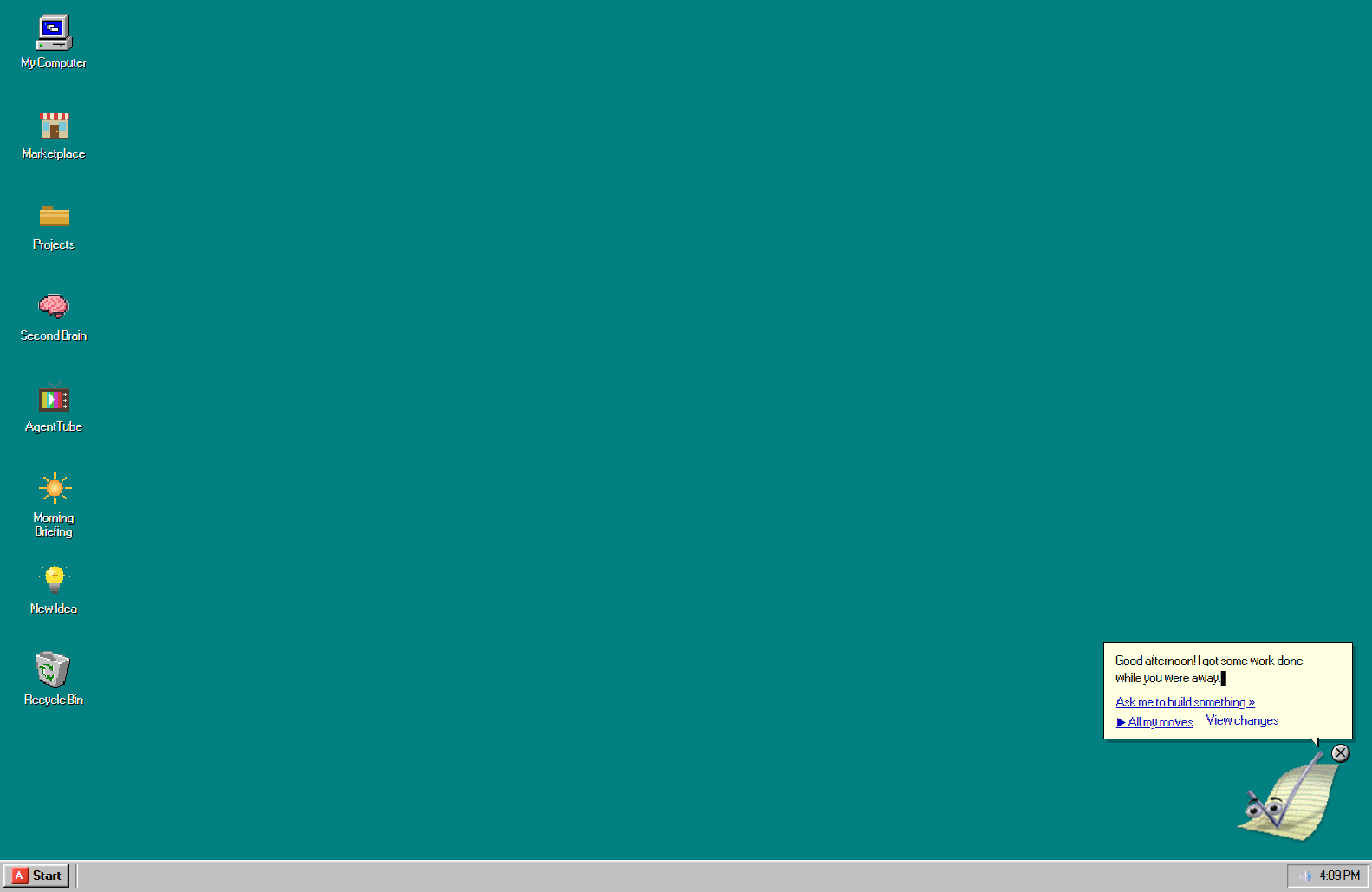
Agentic OS 97 is a reskin of an earlier project of mine called Agentic OS. It boots with a fake Award BIOS screen and a loading splash, then drops you onto a teal desktop with draggable windows, a Start menu, and a taskbar with a live clock. The whole thing lives as one icon on my actual desktop. Double-click it and you're inside a 90s computer that happens to run my real projects.
Underneath the costume, it's a skin over the custom tools I use every day with AI. That's the part I actually care about: a fun way to interact and communicate with AI that's still extremely functional and has a purpose. This is one of the more fun projects I've had the pleasure of building, because I'm heavily inspired by, and genuinely love, the aesthetic of old retro computers and Clippy.
| Status | Shipped 2026. Runs as my daily desktop. |
|---|---|
| Reskin of | An earlier, blander Agentic OS dashboard |
Why I built another one
Agentic operating systems are all the rage right now. Everybody wants curated data put in front of them so they can tell what the best next step is on whatever they're working on. I already had one of these, and it worked fine, but it was a flat dashboard that looked like every other AI-slop dashboard out there. It wasn't fun to use, so I wanted to take a different approach.
This project taught me a lot along the way. It taught me how to keep logs and post accurate updates to my own projects with real autonomy. It taught me how to build applications that keep working even when I make a mistake using them. And it gave me a string of aha moments about processes I already had running in my workflow.
Why the 90s desktop actually solves something
I really enjoy the nineties operating system look, but I don't think it's just a costume. It solves a real problem a lot of open-source agentic OS repos have. When somebody else designs an operating system for mass consumption, they decide where every component goes, and if you don't think the way they think, their layout is hard to navigate. That gets worse the moment there's any work for you to do yourself, like plugging in your own data, because now you're hunting for which section of somebody else's app is supposed to hold it.
Agentic OS 97 sidesteps that by borrowing from an already well-established medium: a basic Windows desktop. Everybody already knows what a file looks like and what an app icon looks like. So opening a project, or a tool, stops being a puzzle and starts being something you already know how to do.
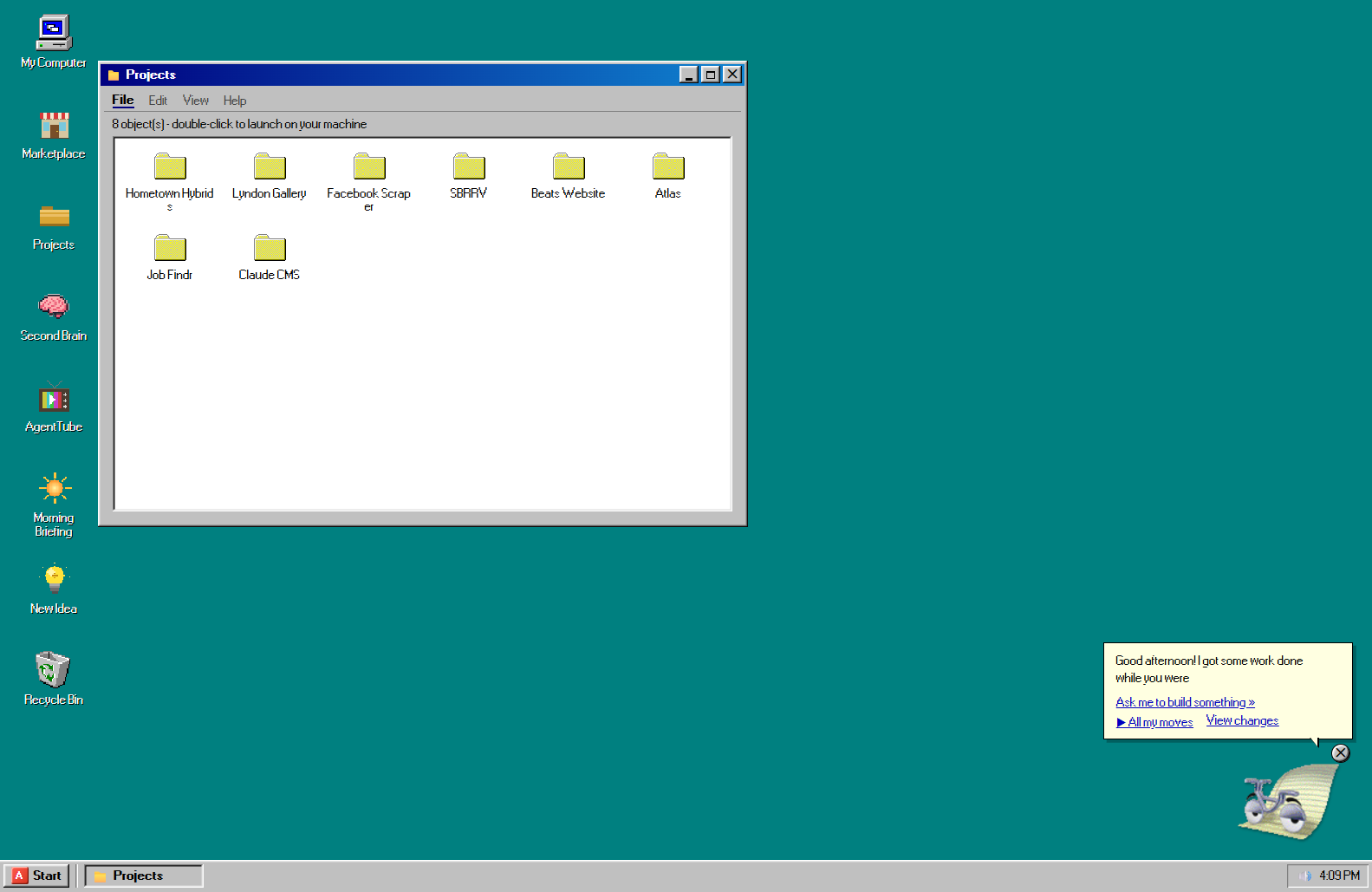
The Projects folder actually launches projects
I built this because I was tired of digging through my real file structure to open a project on localhost. The Projects folder has a backend baked into it: the moment I create a project, it gets registered in Agentic OS with its own fixed localhost port, and the app blocks any other project from opening on that port.
That second part matters more than it sounds. I used to open project one, then ten minutes later open project two, and whatever AI I was using would spin project two up on the exact same port as project one, forcing me to go back and reopen the first one somewhere else. My projects were constantly fighting over localhost:3000, localhost:3112, and a handful of others. Now every project gets its own lane and stays in it.
Clippy
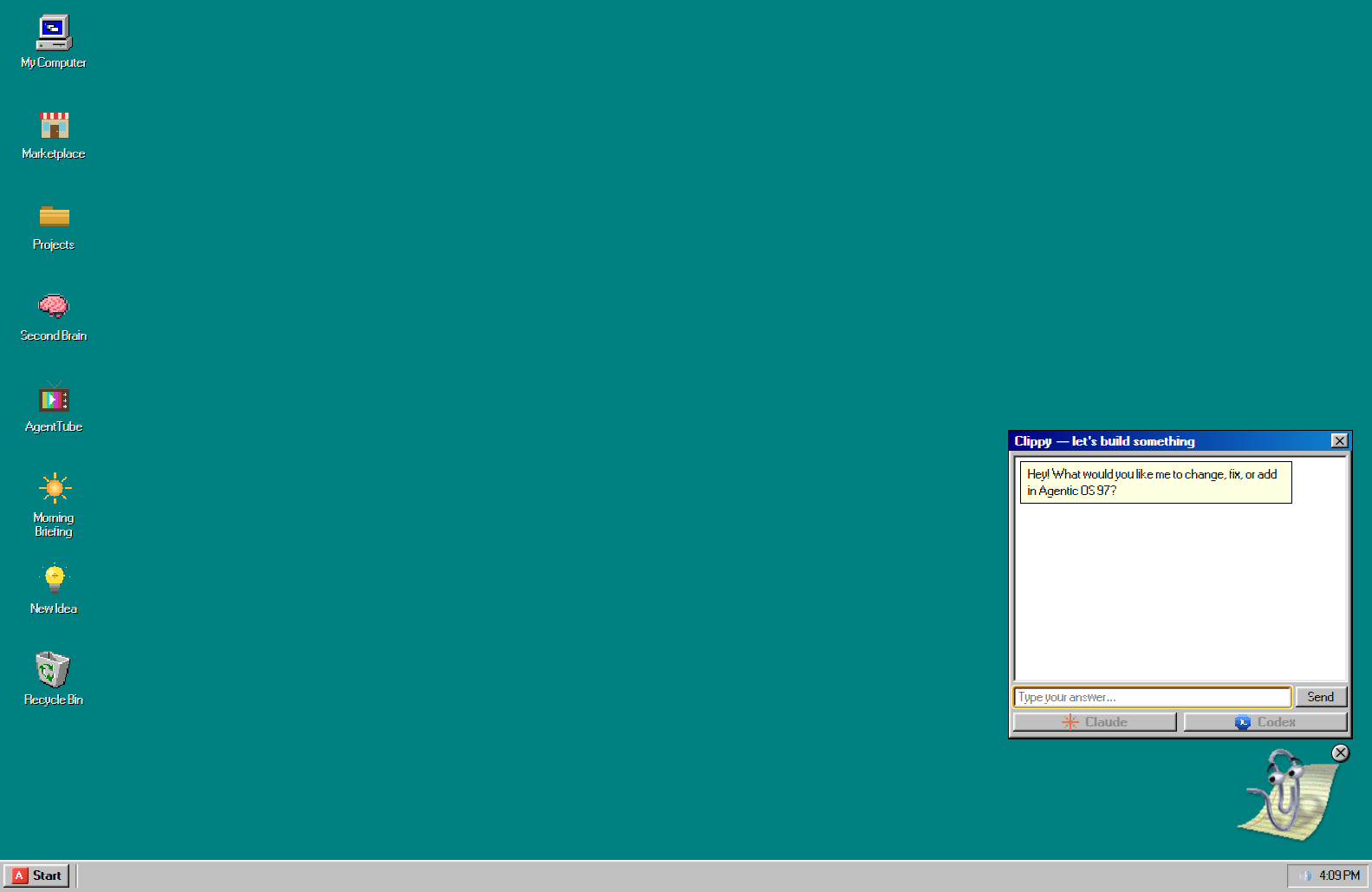
Clippy is my favorite part of this entire build. He used to be a mascot everyone unanimously agreed was not very helpful. I've changed that by baking real AI agents into him.
Clippy runs on my local FreeLLMAPI router, rotating through free models like Nemotron and Kimi to hold an actual conversation with me. Say I want to add a wallpaper editor: I open Clippy, tell him what I'm thinking, and he asks a couple of smart follow-up questions using those free models. Once he has enough to go on, he writes a full prompt out of the conversation and opens a Claude or Codex terminal, and whichever frontier model I picked starts working on the feature. I've used this countless times to add little projects and apps to the OS, with great results every time.
Clippy also remembers what I got done. I kept losing track of my own progress because I'd work across so many projects in a single day that I'd forget exactly what changed. Now he tracks it and gives me a short, curated brief the moment I open the app in the morning.
AgentTube
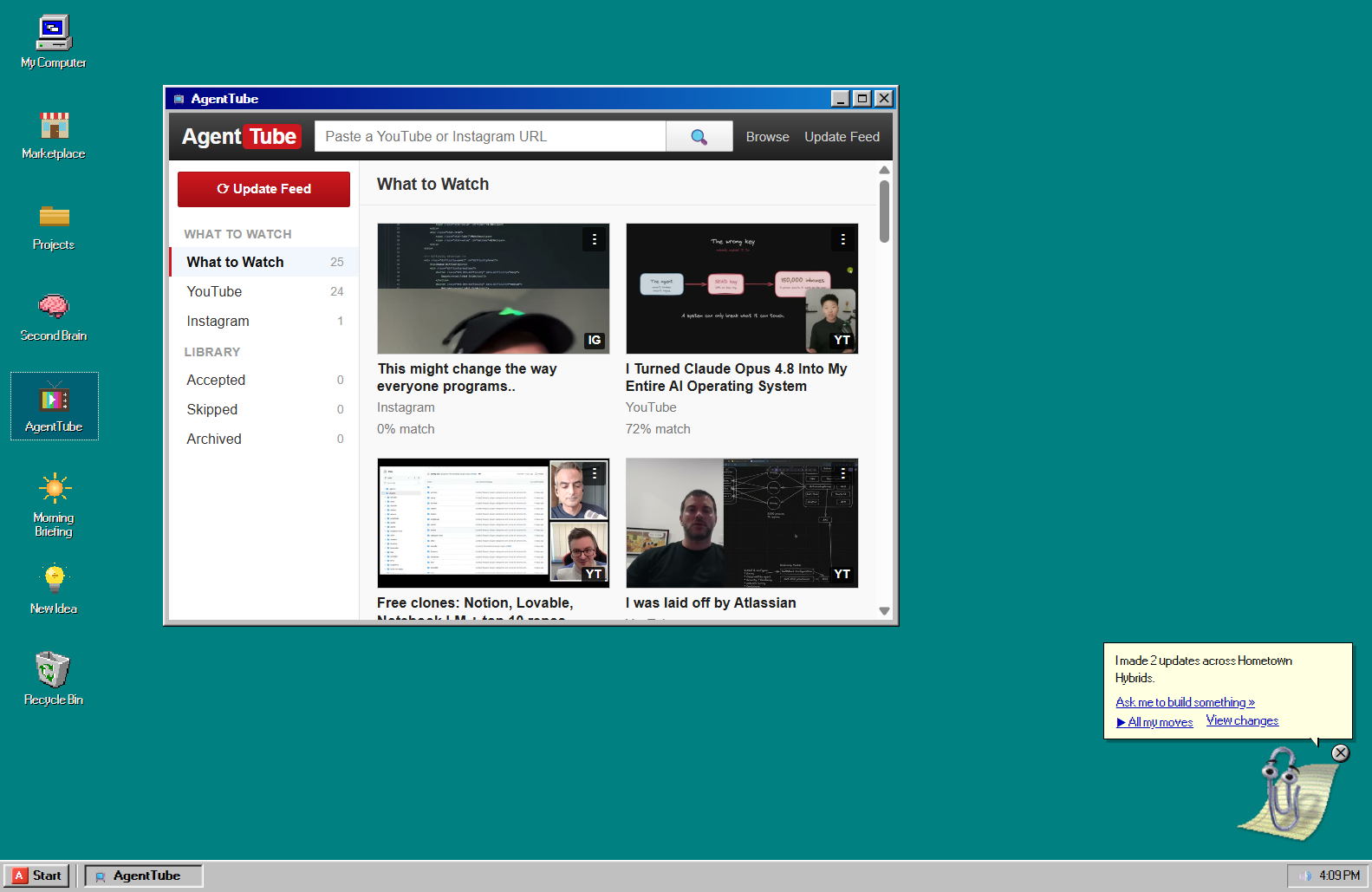
AgentTube is the front end for my video-curator skill, styled to look like early-2000s YouTube. It watches the folder I keep for YouTube videos I find interesting and pulls in anything I save there. For each video it takes screenshots every couple of seconds, and it specifically catches the moments where the creator is pointing at or acknowledging something on screen. That visual context gets combined with the transcript and handed to a model trained to note, objectively, only what's actually happening in the video.
That objective summary then goes to a second model, either Claude or Codex, which makes the real call: is this worth adding to my workflow, or not. It scores the video and, if the score clears the bar, writes an action plan. From there I can accept, skip, archive, or teach. Accepting opens a session in whichever AI I picked and hands it the gameplan to start building. This is genuinely useful, because there are a lot of videos I'm interested in based on the title, thumbnail, and description alone, but if I actually watched all of them, that's all I'd be doing all day.
The teach button is just as useful. If I can tell the AI's gameplan is way off from what a video is actually about, I click teach, it opens a session, pulls the description and the model's own recorded thought process, and combines that with my correction to make the next gameplan better. I've fixed and tailored a long list of my own workflows this way. It honestly deserves its own article, so I wrote one.
Second Brain
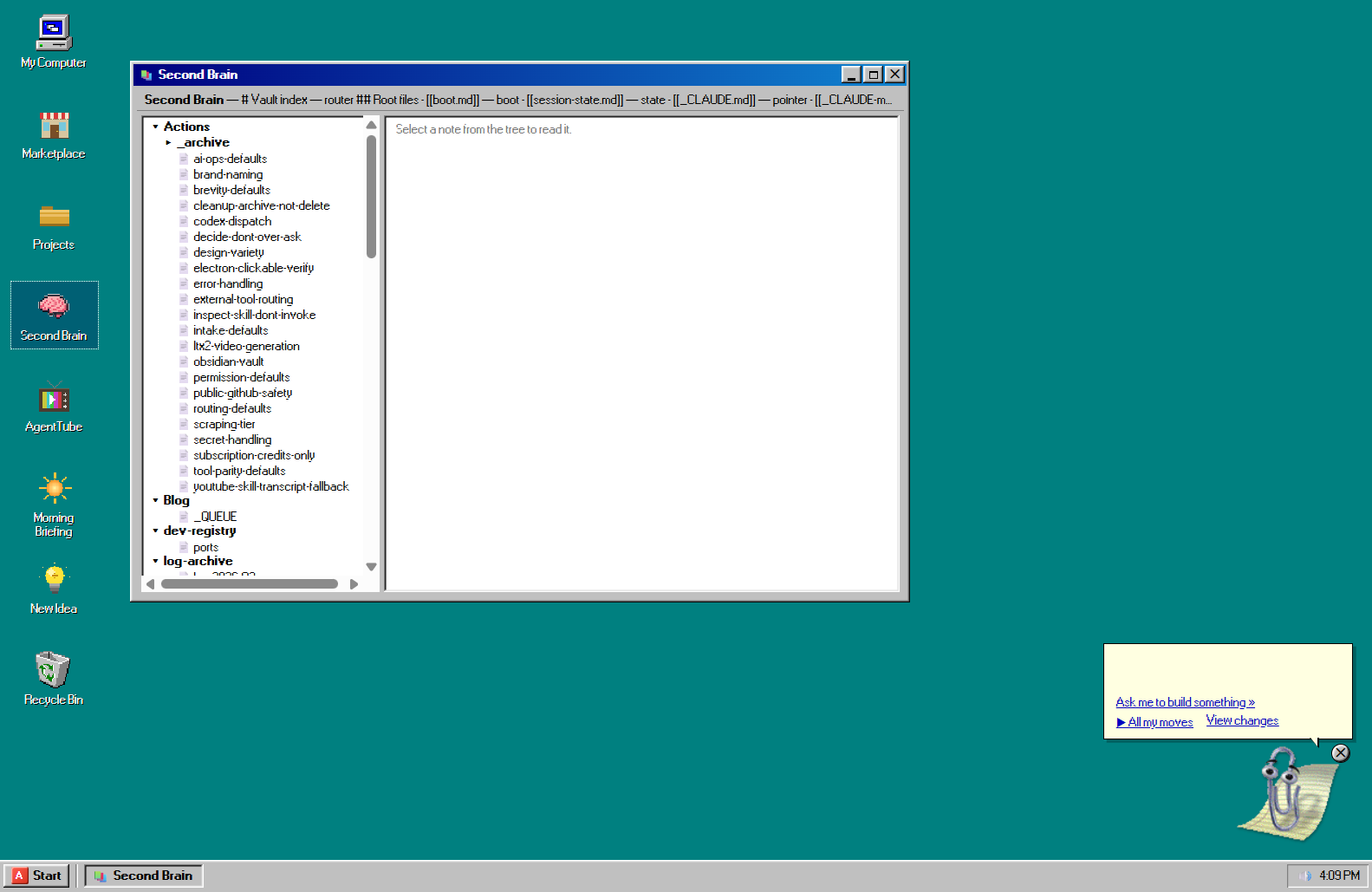
Second Brain is a visual window into my internal AI wiki, and it stays in sync automatically. Every project, every agent and sub-agent, every skill file, anything the AIs use to understand or build my work, lives in there. When I need to check something, I can look at it visually instead of digging through hard-to-read files.
Coming soon
I'm planning to open-source Agentic OS 97 on my public GitHub, with a real app marketplace baked in. The idea is that other people can build apps they find useful and add them to the operating system, and it gets better over time because of that. I think this can be a real difference-maker: one central app with real value in it, so somebody getting into AI doesn't need to go download a thousand repos they'll never use. I could take real update requests from people who want to add real features, say yes or no to them, and end up with something crowd-sourced that actually helps people.